"Flammarion, Camille." Complete Dictionary of Scientific Biography. Vol. 5. Detroit: Charles Scribner's Sons, 2008. 21-22. Gale Virtual Reference Library. Web. 20 Feb. 2015.
"Flammarion, Camille (1842-1925)." Encyclopedia of Occultism and Parapsychology. Ed. J. Gordon Melton. 5th ed. Vol. 1. Detroit: Gale Group, 2001. 571-572. Gale Virtual Reference Library. Web. 20 Feb. 2015.
Friday, February 20, 2015

Monday, January 12, 2015
APOD 2.8
 This stunning photograph shows an observatory in the Caucasus Mountains in Russia in the foreground. The middle layer of the image depicts the scenery of that region, which contains the highest mountain in Europe. Through the clouds, the Milky Way can be clearly seen. Though the cloud cover would probably make it a poor night for observing the sky, it helps create a really remarkable image.
Quarter 2 Observations 2
This quarter, I have continued my observation of the heavens in the following ways:
-I have gone out on most clear nights and looked up at the stars, identifying constellations and celestial objects.
-I observed Venus and Mercury as they approached their closest point in the sky
-I witnessed an Iridium flare as I was driving home
-I observed that the positions of the stars changes drastically with latitude while I was in Virginia over the holiday break.
APOD 2.7
 This is an image of the Geminid Meteor Shower, viewed from high in the mountains in China. In the sky are a few familiar constellations, but the object of the photograph is the fireball in the lower right of the frame. This is a small meteor which burned up in the atmosphere and was most likely the size of a pebble. Meteor showers are truly amazing and I am sad that I missed the Geminid shower, but I got a great view of the Perseid Meteor Shower in rural Minnesota.
APOD 2.6
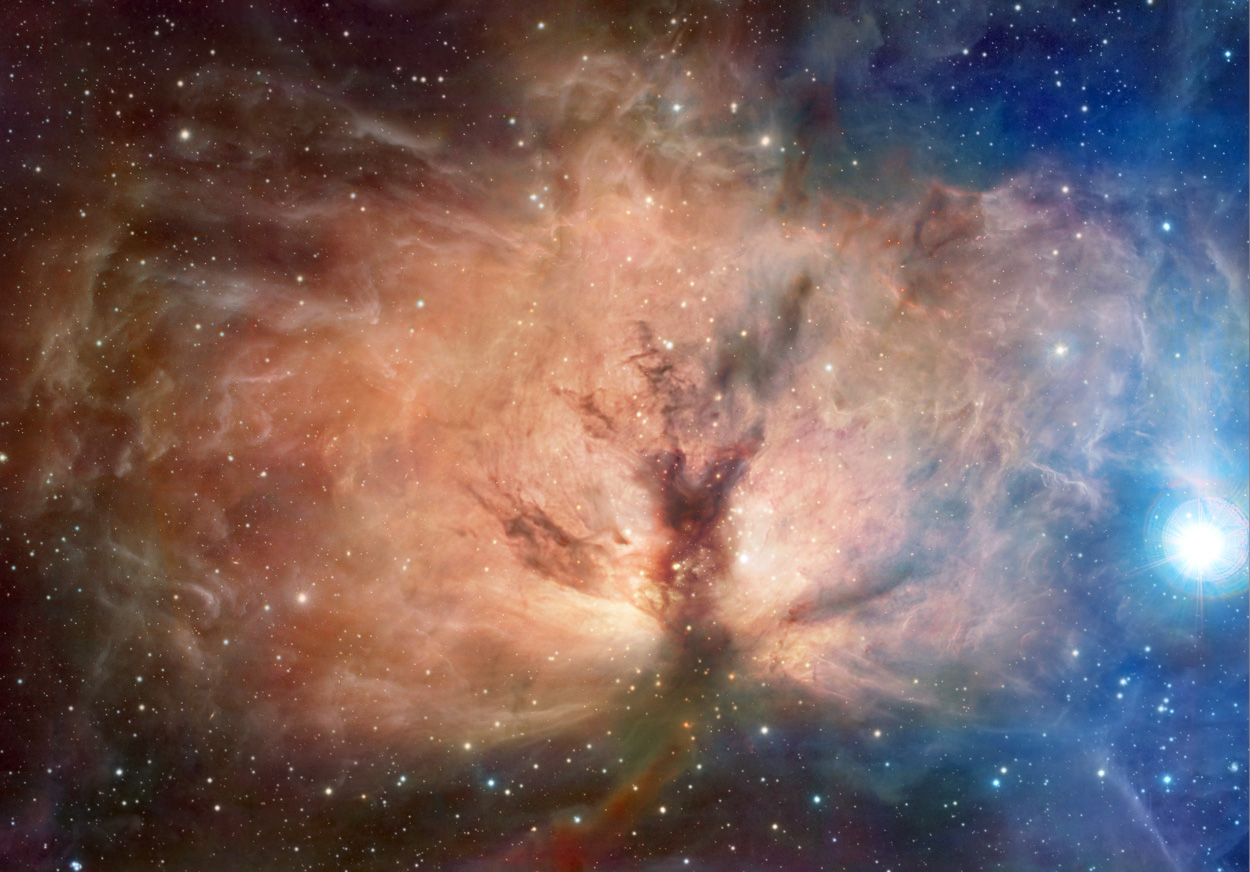 This image depicts the Flame Nebula, a stunning formation that is lit by the nearby star Alnitak, in Orion's belt. The star is a blue supergiant, one of the most incredible types of stars in existence. With a radius greater than our solar system and a temperature far exceeding that of our sun, the energy emanating from this object is simply astounding. If this star were not several hundred parsecs away, it would easily be one of the brightest stars in the night sky.
Quarter 2 Observations 1
In the first half of this quarter, I made many observations in the night sky including:
-Observing the sky on nearly every clear night and observing the daily shift in the positions of stars
-Also every night becoming familiar with constellations and being able to identify them
-Observing the sky from a different latitude while on a trip to Tennessee
-I noted that the positions of stars were very different and I had trouble identifying some constellations.
-Observing the motions of Mars and Jupiter as they moved across the sky
APOD 2.5
 This is an image of the lunar surface, focusing on the 95 km wide crater Plato, with the lunar alps to the right. The lunar alps were formed, not by tectonic activity like the alps on Earth, but by impacts from meteors which deformed the moon's surface. These mountains are still very impressive, with a length of 160 km and the highest peak reaching over 3 kilometers high.
Subscribe to:
Posts (Atom)