Sunday, March 29, 2015
Observations

Thursday, March 5, 2015
Quarter 3 Biography
Camille Flammarion was born on February 26, 1842 and died on
June 3, 1925. His parents were not wealthy and they owned a store when he was
born. Astronomy interested him from a young age, ever since he was able to see
a solar eclipse for the first time at age 5. His parents were then forced to
move to Paris, which Flammarion took in stride as it gave him many more
opportunities to better himself. He worked hard and took on a part time job as
well as studying rigorously. Pure chance led a doctor who was treating him to
read some of his writing and this doctor showed it to Le Verrier, the director
of the Paris observatory, who immediately hired Flammarion onto his staff.
Flammarion continued writing and soon was having his works
published. His first published work was La
pluralité des mondes habités, during whose writing he first encountered spiritualist
Allan Kardec and joined his Society for Psychologic Studies. At the meetings of
this Society, the members performed séances to promote inspirational writing.
Soon Flammarion was supposedly able to conjure up words and images from beyond
this world. Some of the writings he acquired were Galileo’s work and even
signed by him, but Flammarion refused to accept this and saw them as entirely
his work. The Society eventually published these papers. Flammarion soon gained
access to the inner Spiritist circles in Paris, but never became a Spiritist
himself.
Flammarion also made many flights in hot-air balloons to
study atmospheric phenomena. During this time he wrote his most famous book, Astronomie Populaire, which was
translated into many languages and spread interest in astronomy throughout the
world. He also compiled all contemporary astronomical observations of the
planet Mars into one volume, La planète
Mars et ses conditions d’habitabilité. This title is because scientific
opinion at the time held that Mars was the only planet that could potentially
support life.
Flammarion’s greatest accomplishment, however, was spreading
interest in astronomy through his Popular
Astronomy, especially since for the first time during this era, high-quality
consumer astronomical equipment was becoming available to many people. His
works have influenced astronomy for many years and the interest gained in
astronomy as a result of his works has shaped the field to this day.
Friday, February 20, 2015
Quarter 3 Biography Sources
"Flammarion, Camille." Complete Dictionary of Scientific Biography. Vol. 5. Detroit: Charles Scribner's Sons, 2008. 21-22. Gale Virtual Reference Library. Web. 20 Feb. 2015.
"Flammarion, Camille (1842-1925)." Encyclopedia of Occultism and Parapsychology. Ed. J. Gordon Melton. 5th ed. Vol. 1. Detroit: Gale Group, 2001. 571-572. Gale Virtual Reference Library. Web. 20 Feb. 2015.
"Flammarion, Camille (1842-1925)." Encyclopedia of Occultism and Parapsychology. Ed. J. Gordon Melton. 5th ed. Vol. 1. Detroit: Gale Group, 2001. 571-572. Gale Virtual Reference Library. Web. 20 Feb. 2015.
Monday, January 12, 2015
APOD 2.8
 This stunning photograph shows an observatory in the Caucasus Mountains in Russia in the foreground. The middle layer of the image depicts the scenery of that region, which contains the highest mountain in Europe. Through the clouds, the Milky Way can be clearly seen. Though the cloud cover would probably make it a poor night for observing the sky, it helps create a really remarkable image.
Quarter 2 Observations 2
This quarter, I have continued my observation of the heavens in the following ways:
-I have gone out on most clear nights and looked up at the stars, identifying constellations and celestial objects.
-I observed Venus and Mercury as they approached their closest point in the sky
-I witnessed an Iridium flare as I was driving home
-I observed that the positions of the stars changes drastically with latitude while I was in Virginia over the holiday break.
-I have gone out on most clear nights and looked up at the stars, identifying constellations and celestial objects.
-I observed Venus and Mercury as they approached their closest point in the sky
-I witnessed an Iridium flare as I was driving home
-I observed that the positions of the stars changes drastically with latitude while I was in Virginia over the holiday break.
APOD 2.7
 This is an image of the Geminid Meteor Shower, viewed from high in the mountains in China. In the sky are a few familiar constellations, but the object of the photograph is the fireball in the lower right of the frame. This is a small meteor which burned up in the atmosphere and was most likely the size of a pebble. Meteor showers are truly amazing and I am sad that I missed the Geminid shower, but I got a great view of the Perseid Meteor Shower in rural Minnesota.
APOD 2.6
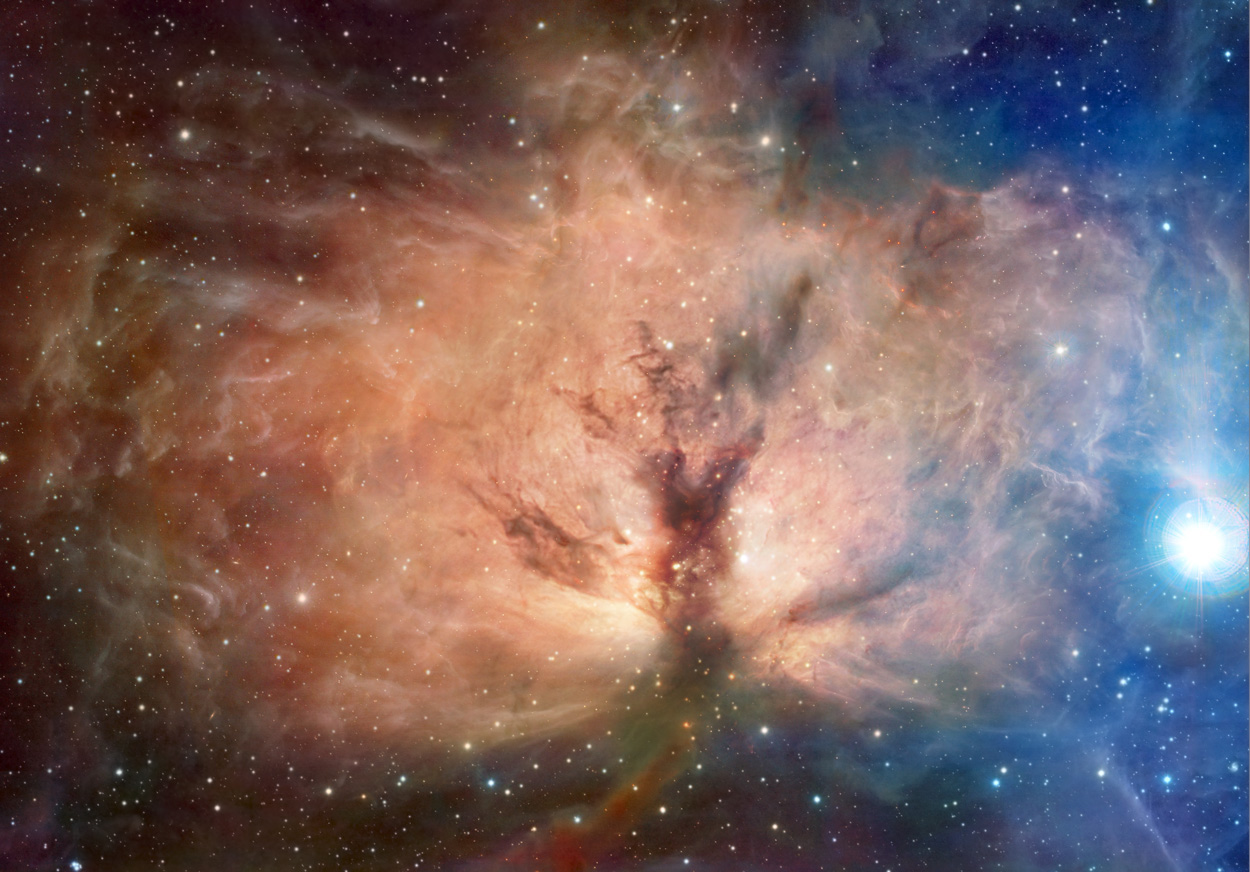 This image depicts the Flame Nebula, a stunning formation that is lit by the nearby star Alnitak, in Orion's belt. The star is a blue supergiant, one of the most incredible types of stars in existence. With a radius greater than our solar system and a temperature far exceeding that of our sun, the energy emanating from this object is simply astounding. If this star were not several hundred parsecs away, it would easily be one of the brightest stars in the night sky.
Subscribe to:
Posts (Atom)